


There was a time—before we adjusted ourselves to the fast tempo of the modern world—when people still listened to the signals of their bodies. They knew when to stop, when to take a deep breath, when to pay attention. Eastern movement systems were born from this older wisdom: not to improve performance, but to live in a more harmonious relationship with life itself.
But which path speaks to you? Qigong, tai chi or yoga?
Three different answers to the same question: How can I live without losing my life-force to everyday pressures?
Qigong: deep calm & letting change happen instead of forcing it
Qigong appeared 4–5 thousand years ago not to make us strong, but to help us stop losing the strength we naturally have. Movements are simple, as if the body finds them by itself. There is no pushing, no struggling; it’s more like finally exhaling after holding your breath for far too long, and noticing there was no need to hold it at all.
In qigong we don’t reshape the body—we listen to it. The movement is slow, but alive; the breath is subtle, yet transformative. The life-force (qi) begins to move, and we do not force it—we guide it gently, the way a riverbed shapes the water without holding it.
Over the centuries, different schools of qigong emerged, depending on whether the focus was martial arts, healing, or spiritual cultivation. Their goals and methods may differ, yet the foundations remain the same.
Characteristics:
- built on simple, easily learnable movements
- based on the natural, unforced breath
- its aim is to harmonise life-energy (qi)
- has both seated/internal (Nei Dan) and moving (Wai Dan) practices
Qigong does not strain, does not force the body into shapes that don’t belong to it, and does not rely on heavy breath control. It guides, allows, softens, realigns.
Tai Chi: harmony in motion
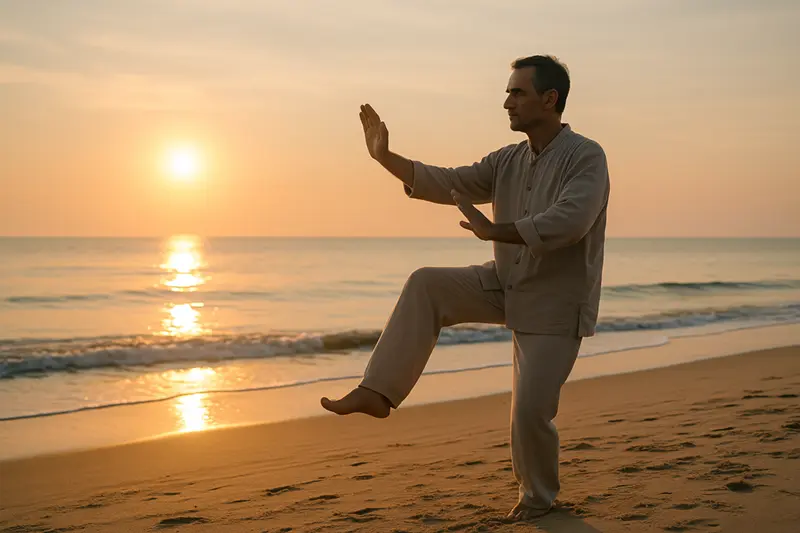
Tai chi chuan is around 500 years old—we might call it the “grandchild” of qigong. It feels like a long poem: it has rhythm, structure, and a subtle story told through the body.
A soft martial art—not to win fights, but so that we no longer need to fight. Its movements were born from qigong, but are more choreographed, longer, and sometimes feel like dancing with something invisible.
The deeper someone practises, the more they realise that the real battle is not outside. What we’re quieting down is the inner survival mode that constantly keeps us tense. Tai chi teaches presence without fighting—without even fighting yourself.
Characteristics:
- choreographed sequences that follow a set order
- practised as moving meditation (Wai Dan)
- harmonises the body’s energy, just like qigong
Its health benefits are very similar to qigong. The difference is simply that tai chi is more structured, takes longer to learn, and carries clear martial roots.
📌 Scientific research
Qigong and tai chi have nearly identical health benefits. Studies show improvements in:
- bone density
- immune function
- anxiety and depressive symptoms
- quality of life, especially in older age
- spine, joints, circulation and breathing
Most research only examines the moving practices. The seated, internal (Nei Dan) aspect of qigong is still far less studied.
Source: A Comprehensive Review of Health Benefits of Qigong and Tai Chi
How does yoga fit into this picture?
What yoga is to India, qigong is to China. The roots of yoga and qigong can be traced back to a shared historical figure: Bodhidharma (Damo).
The two paths later separated, but their foundations remain the same:
- natural breath
- conscious awareness
- movement and mind working together
Yoga carries the beauty of discipline. Poses can be demanding because they speak to parts of us we haven’t used in a long time. The body asks, the attention focuses, the breath is tuned and trained. It isn’t always easy. It doesn’t have to be. Yoga is not gentle by softness, but by structure. It supports by giving form, holding us in a clear frame.
The shared aims of both yoga and qigong:
- cultivating life-force
- maintaining health
- longevity
- awareness and self-knowledge
- spiritual growth and unity
What truly distinguishes them?
If we had to express it in one sentence:
- Yoga: “Control your body and breath, and then relax into it.”
- Qigong: “Observe your body and breath, and allow them to change.”
- Tai chi chuan: “Hold your attention and move within a precise rhythm—you will settle into it.”
All three teach the unity of body and mind. They simply enter through different doors.
- In yoga, the body is the gateway.
- In qigong, the energy flow is.
- In tai chi, it is the mindful flow of movement.
Which path suits whom? – 4 + 1 considerations
1) Personality
- Prefer clear external guidance? → Yoga
- Tend to push yourself too hard? → Qigong
- Only have time once or twice a week? → Yoga classes
- Can commit to 15 minutes daily? → Qigong
- Enjoy precise sequences? → Tai chi chuan
- Prefer adaptable, mood-based practice? → Qigong
2) External goal
- Visible strength and flexibility → Yoga
- Harmony, presence, peaceful radiance → Qigong
- Elegant, mesmerising movement → Tai chi chuan
Qigong does not build “over-developed muscles”, because excessive tension blocks the free flow of qi.
3) Physical condition
- Limited mobility, chronic illness, ageing → Qigong (can be done seated or lying)
- Yoga: effective, but more physically demanding
- Tai chi chuan: gentler than yoga, but does not include seated/lying practice
4) Where do you prefer to practise?
- Yoga and tai chi: mainly attended classes, slower path to independence
- Qigong: taught in a course format → you become independent from the beginning, supported by regular practice (and regular group sessions if you wish)
+1) Which one do you want the most?
The body knows what you need. Listen to it.
All three can support you, even side by side—just don’t mix their methods within the same practice. Yoga strengthens and sculpts the body. Qigong cultivates deep calm, inner stability, and a more grounded vitality. Qigong stands out in one way especially: it is gentle, adaptable, and accessible regardless of age or health. Tai chi and qigong share the same roots—only their forms differ.
The best path is the one you can return to with genuine willingness, again and again.
If you’d like to explore qigong yourself:
You’re welcome to start with a Qigong Experience or immerse yourself in the Ningjing Qigong Basic Course .

