
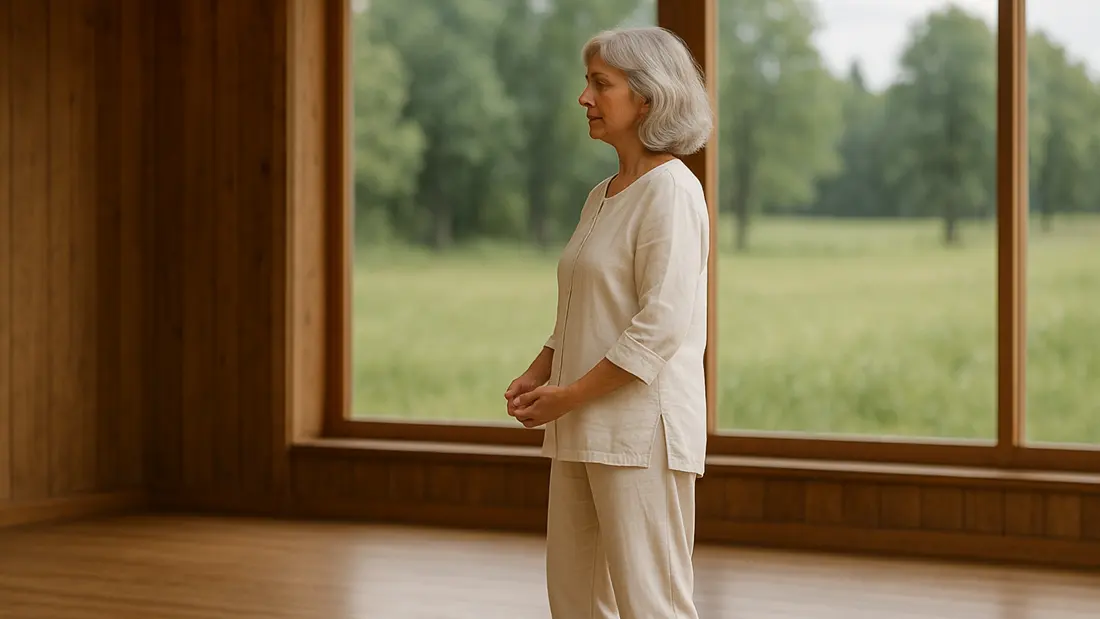

Dr. Andrea Gombkötő’s Experience and the Inner Process of Qigong

“In 2013 I developed a health condition that restricted my movement. I lived from moment to moment in recurring, almost constant pain. At the end of the year my teacher, Edina, offered me the possibility of practicing qigong. I found the idea wonderful and inviting. But the road that led to effortless practice was rather rocky. The collision of one bone against another (without proper joint movement) can be painfully overwhelming.”
— Dr. Andrea Gombkötő
During the first weeks, the Zhan Zhuang practice — also known as Tree Standing — did not bring ease or harmony. It brought pain, struggle, and a restless mind. Her account shows how she moved from pain to silence.
“When the time came to stand for 30 minutes in the Tree posture, my teacher — aware of my movement difficulties — always reminded me: ‘Andrea, you can stop at any time if you need to.’ I rarely took that option, even though the initial 10–20 minutes were agonizing. Time moved like lead. Every minute felt like a century. My mind took control over my body, thoughts racing back and forth. It took great discipline to finally arrive in the state of ‘here and now.’”
(At the time, Andrea was working as a lawyer. Today, she is a highly trained naturopath.)
What Actually Happens in the Body?
Tree Standing is not about “pushing through” or “enduring to the end.”
Its essence is gentle adaptation — of both body and consciousness.
It is an autonomic reorganization that unfolds in three stages:
1) The body resists
The posture is unfamiliar.
The body tries to return to old postural habits.
Unaccustomed load creates tension, fatigue, and even pain—this happens to healthy beginners as well.
This is simply the body’s story so far.
2) The mind rebels
Time slows down. Thoughts speed up. There is a desire to escape.
The body is ready to change, but the mind clings to control.
The brain and the mind need 10–20 minutes to shift—to reorganize into what we call the qigong state.
3) Transition: the body begins to self-organize
When the practitioner stops fighting and starts releasing, breathing deepens, and the nervous system shifts into parasympathetic mode. Tension softens. Pain changes form.
This is the moment Andrea called “the miracle”:
“In the beginning, the shift happened after about 20 minutes, later after only 10 minutes. Suddenly the racing thoughts were gone. The imagined past and future disappeared. Only the present moment remained. I heard the sounds of the inner garden, the rustle of flowers, and felt the peaceful rhythm of my heart. The pain that once filled my body dissolved, and even the uncomfortable sensation of two bones colliding turned into a subtle tingling. The free flow of qi throughout my body completely liberated me.”
It was not the body that “healed.”
Tree Standing allowed her to drop out of survival mode.
The transformation of pain arose from the quiet that formed beneath the posture—where the body could finally reorganize itself.
From a Scientific Perspective

Translated into medical language:
- Stress-related inflammation decreases, and pain threshold rises.
- Static standing activates deep stabilizing muscles.
- Attention and breath regulate the autonomic nervous system.
- Increased parasympathetic activity reduces pain perception.
- Postural adjustment improves circulation and joint load distribution.
Translated into qigong terminology:
Qi begins to flow freely — not because we “move it,” but because the obstruction is gone.
Why is the Tree Standing Meditation so powerful?
Because it’s not a technique.
And it’s not a performance.
During Tree Standing meditation practice we don’t do more — we actually do less:
- we stand
- we breathe
- we pay attention
- we soften
And while we do this, we allow the body to reorganize itself.
This is the moment when the practice shifts from qigong to neigong — when body, breath, and mind begin to align, and inner power doesn’t come from effort or will, but from a natural process of self-organization.
In essence
Zhan Zhuang practice is not about “overcoming pain.”
Not about “fixing the body.”
Not about a “mental breakthrough.”
It’s about that moment when you stop trying to do anything —
and something still happens.
It’s not us moving the energy.
It’s the energy moving us when the inner silence finally has space to open.
If you’d like to experience this for yourself:
You’re welcome to start with a Qigong Experience or immerse yourself in the Ningjing Qigong Basic Course .

